
When Curiosity Returns: How Horses Reopen the Door to Choice
Guest Author: Janis Cooper | President, Coach & Facilitator of Change | Janis Cooper Consulting / EQnimity, LLC
There is a moment in almost every equine-assisted session that I’ve come to look for — a moment when a person stops trying to “get it right” and starts wondering, “What’s happening between us?”
It’s subtle, but unmistakable. Something softens, then expands. Something becomes possible.
Curiosity returns to the body.
And that moment, more than any technique or exercise, is the beginning of choice.
The Body Opens Before the Mind Understands
Curiosity isn’t intellectual. It’s somatic.
It emerges when the nervous system shifts out of vigilance into presence — when the body feels safe enough to wonder rather than monitor or protect.
Horses help make that shift possible.
I once worked with a recently graduated college student whose world had been upended by a medical crisis. Though her body had healed, her mind remained braced for the next bad thing. She lived in constant forecasting — scanning the future, her body, and the environment for signs she was “okay.”
In the round pen, she stood with a gray draft horse gelding named Free — a grounded, observant presence along the rail. My client tried deep breaths, but each time she began to settle, she would open her eyes to check: Is he coming toward me yet? Am I doing this right? Is anything happening?
Her checking wasn’t impatience.
It was fear disguised as vigilance — the opposite of curiosity.
And each time she dipped into genuine presence — when her breath softened or her shoulders loosened — Free would subtly orient toward her. But the instant she sought confirmation, his attention paused.
It was as if he were saying: I’ll meet you when you trust the moment, not when you chase the outcome.
The session became a silent dance: her tentative movement toward presence, Free’s response, and her mind snapping back into control — curiosity collapsing into self-monitoring.
At the sessions end, something shifted.
When I asked what she was taking away, she paused — really paused. She didn’t check Free or me. She checked inward. Her breath slowed, and she released a long, unguarded sigh.
At that moment — the moment curiosity truly returned — Free stepped off the rail and walked directly toward her.
Her curiosity had finally replaced her vigilance.
And with it came connection, clarity, and choice.
Curiosity Turns Reactivity Into Choice
When curiosity stirs, behavior changes:
We move from reaction to responsiveness.
From automatic patterns to intentional presence.
From pushing the world to partnering with it.
Curiosity creates a pause — a gentle, powerful opening where new choices emerge. It interrupts the habits we’ve practiced for years and invites us into something more authentic and relational.
In the presence of a horse, curiosity isn’t a concept. It’s a lived experience.
Why Curiosity Matters for Leadership
Curiosity may be the most underrated leadership competency we have.
Leadership without curiosity becomes control: rigid, defensive, task-focused, and transactional.
Leadership with curiosity becomes connection: open, relational, adaptive, and embodied.
When leaders become curious, they:
listen differently
see other’s perspectives
approach conflict with openness rather than certainty
become more flexible under pressure
shift from managing people to partnering with them
Because horses respond to internal state rather than external performance, they reflect this instantly. Leaders feel the difference between forcing connection and allowing it.
The insight is visceral:
“When I soften, things change. When I notice instead of force, connection appears.”
This is leadership learning at its most embodied.
What Curiosity Asks of Equine Practitioners
Curiosity isn’t only a gift to participants — it’s a compass for practitioners.
Those of us who facilitate this work know that curiosity must be invited and protected. Our role is not to explain the experience but to create the conditions where inquiry can arise.
1. We ask questions instead of offering answers.
Curiosity grows when we create openings:
“What did you notice in your body?”
“What do you sense the horse responding to?”
2. We stay grounded in our own bodies.
Our regulation shapes the session. A calm practitioner helps create the safety necessary for curiosity to emerge.
3. We normalize discomfort.
Curiosity rarely appears when people feel fully competent; it emerges when uncertainty feels safe enough to explore.
4. We protect the space from performance.
When participants slip into “doing it right,” curiosity tightens. We guide them back to noticing.
5. We honor the horse as partner, not tool.
Curiosity thrives when every being in the arena is respected.
As practitioners, we don’t teach curiosity — we embody it.
Curiosity as the Root of Choice
What emerges when curiosity is present is not just insight — it’s choice.
Choice to respond instead of react.
Choice to breathe instead of brace.
Choice to lead from groundedness instead of pressure.
Choice to see the horse — and ourselves — with clarity and compassion.
In a world that pushes us toward certainty and control, curiosity brings us back to presence. Horses, in their quiet wisdom, help us remember how to find it.
Curiosity widens the path.
Choice walks us through it.
And both begin in the body.
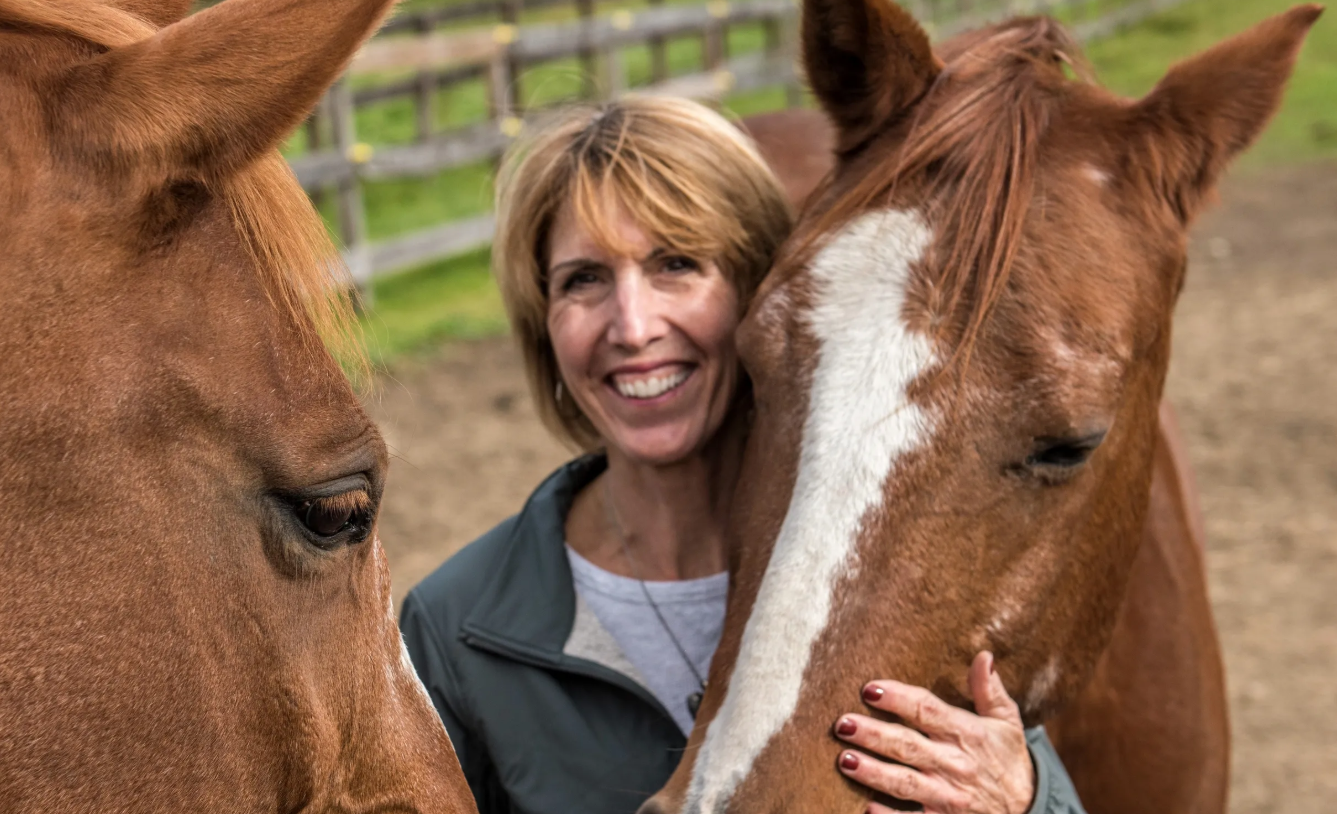
Janis Cooper is a leadership development professional, coach and equine-assisted learning facilitator who believes that awareness—of self, of others, and of the moment—is where real change begins. Through her practice, EQnimity, and her work at Best Friends Animal Society, she helps humans work better with humans. Her work also includes partnering people with horses to reveal what’s possible when we lead from presence, connection, and curiosity.
